
Description of Bolton Township
Bolton Township is the largest of the Eastern Townships, with 62,621 acres. It was created by the British Governor of Canada, British North America, in 1797.
It is bordered to the north by Shefford, Stukely, and Orford (presumably originally Oxford) townships, to the east by Lake Memphremagog, to the south by Potton Township, and to the west by Brome Township.
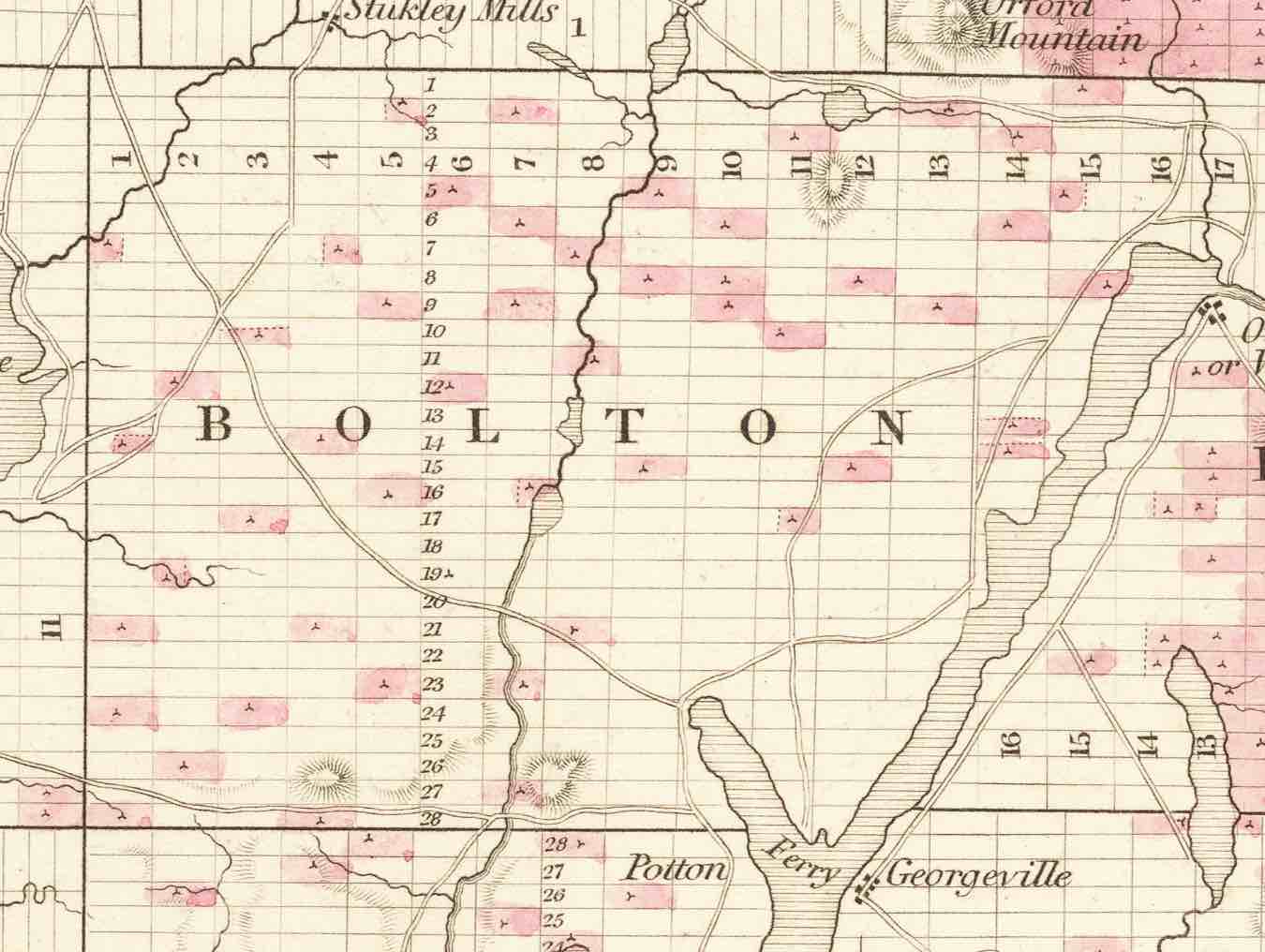 Carte de Bolton, Wells, 1839
It is crossed from north to south, in its center, by the Appalachian mountain range as well as by the Missisquoi Valley and the North Missisquoi River. This division into three parts determined its development with a part facing west, a part facing east, leaving a central part in the Missisquoi Valley. Almost everywhere along the Eastern Townships Autoroute, the pavement was built at the natural ground level, except in the township of Bolton where it was built below the natural ground level. This demonstrates that the Appalachian mountain range crosses southern Quebec, in a northerly direction, through the townships of Potton and Bolton.
Here is what Joseph Bouchette, Surveyor General of Lower Canada, had to say about it in his 1815 work entitled "Topographical Description of the Province of Lower Canada" (p. 276):
"Bolton is one of the first townships to be formed. Its surface is uneven and somewhat mountainous, being crossed diagonally by a chain of heights, where several rivers have their source, which divides the waters that flow into the Yamaska and other large rivers to the north from those that empty into Lake Memphremagog and the North Missisquoi, in the opposite direction. The lands in the lower parts are fairly good, but those to the west are the best, and there are some fine, well-cultivated settlements that produce all kinds of grain."
The North Missisquoi River, which was once called the Black River, rises in Lac d'Argent to the north in Eastman, crosses the townships of Bolton and Potton to the south and becomes a tributary of the Missisquoi River which will reach Lake Champlain to the west. Lake Memphremagog is the major attraction of the region which includes Bolton Township. The lake was formed some 12,500 years ago by the melting of glaciers which left a large glacial lake that covered most of the township and neighboring townships.
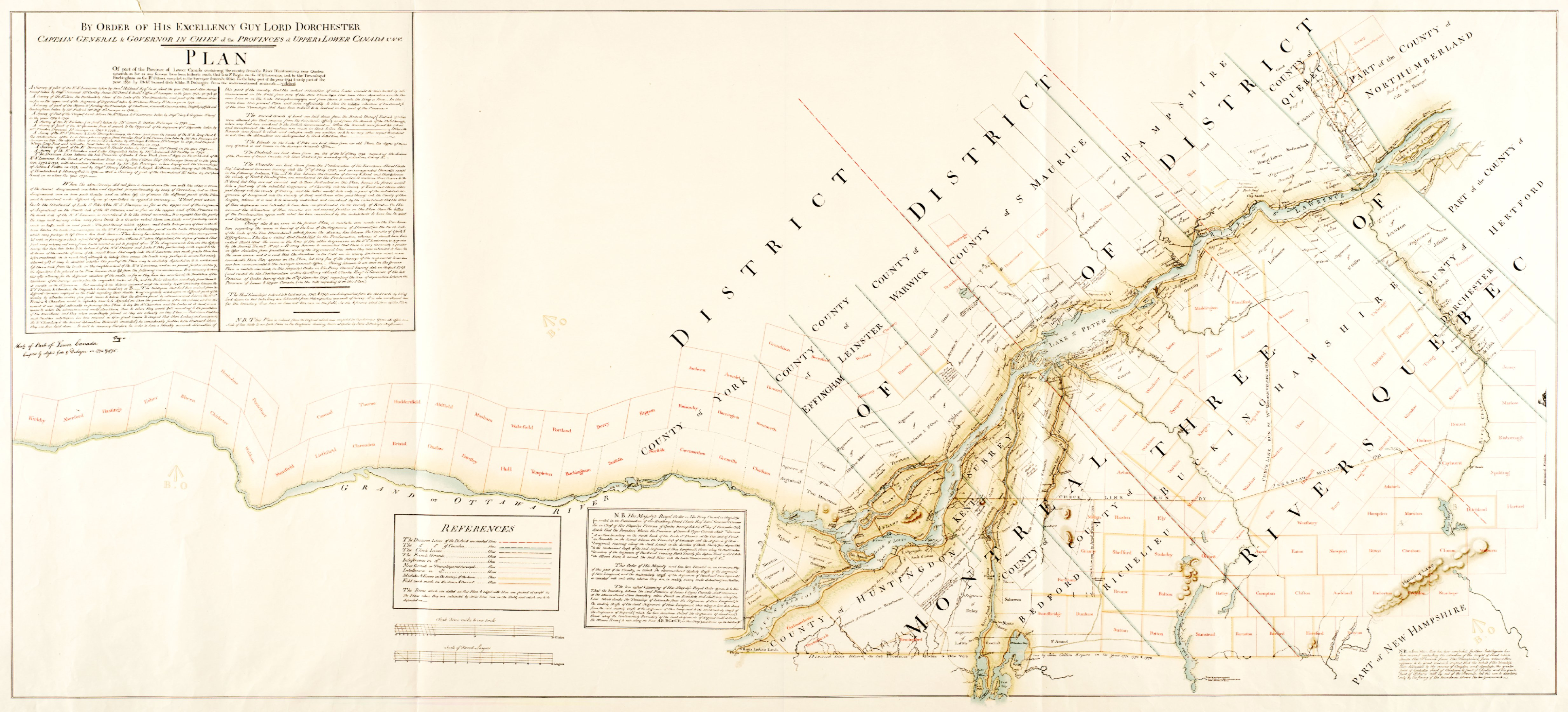 Carte Gale et Duberger, 1795
According to Wikipedia, the township was named after Harry Powlett, 6th Duke of Bolton. However, this is uncertain, as surveyors often randomly chose the names of estates or villages in England to name townships.
According to the Gale and Duberger map opposite, Bolton was part of the District of Montreal and the County of Richelieu at the time of its creation.