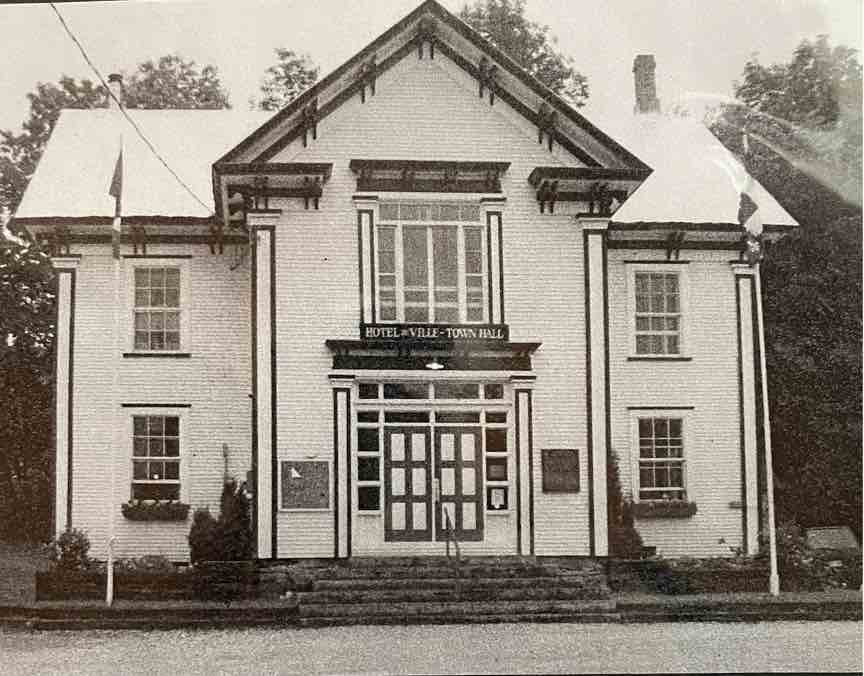
 Hôtel de ville de Bolton
Bolton Centre Town Hall by HB Schuffelt
An important event took place in this village in 1867. The municipal Council of the Township of Bolton acquired one quarter acre of land on the west side of the street and built a Town Hall. A subscription had been taken up to aid « the building of a Town Hall with the understanding that it shall be finished convenient for public worship and opened on Sundays and at other times when needed, if not required for town purposes». A total of $479.00 was subscribed by 34 persons.
The citizens petitioned also that a suitable room be provided in the Town Hall for a school since the one being used was in an untenantable condition. As there was no church edifice in the village until about 1874, Public Worship was probably conducted here for seven or eight years.
A Model School with two teachers was conducted in this building for several years in the early 1900's. Among the teachers at this model school was H. A. Honeyman who later became one of the School Inspectors of this province. Charles Chamberlain, a successor to Mr. Honeyman, as principal of the Model School here, became a famous church organist in Montreal and New York City. Other teachers here were Lillian Blaisdell (later Mrs. Henry Peasley) and Miss Hattie Shufelt (later Mrs. F. P. Wiliams). Down through the years this Town building has been the social centre where concerts, socials and suppers have been held and still are.
Source : Yesterday's of Brome County, Vol. 3, 1977
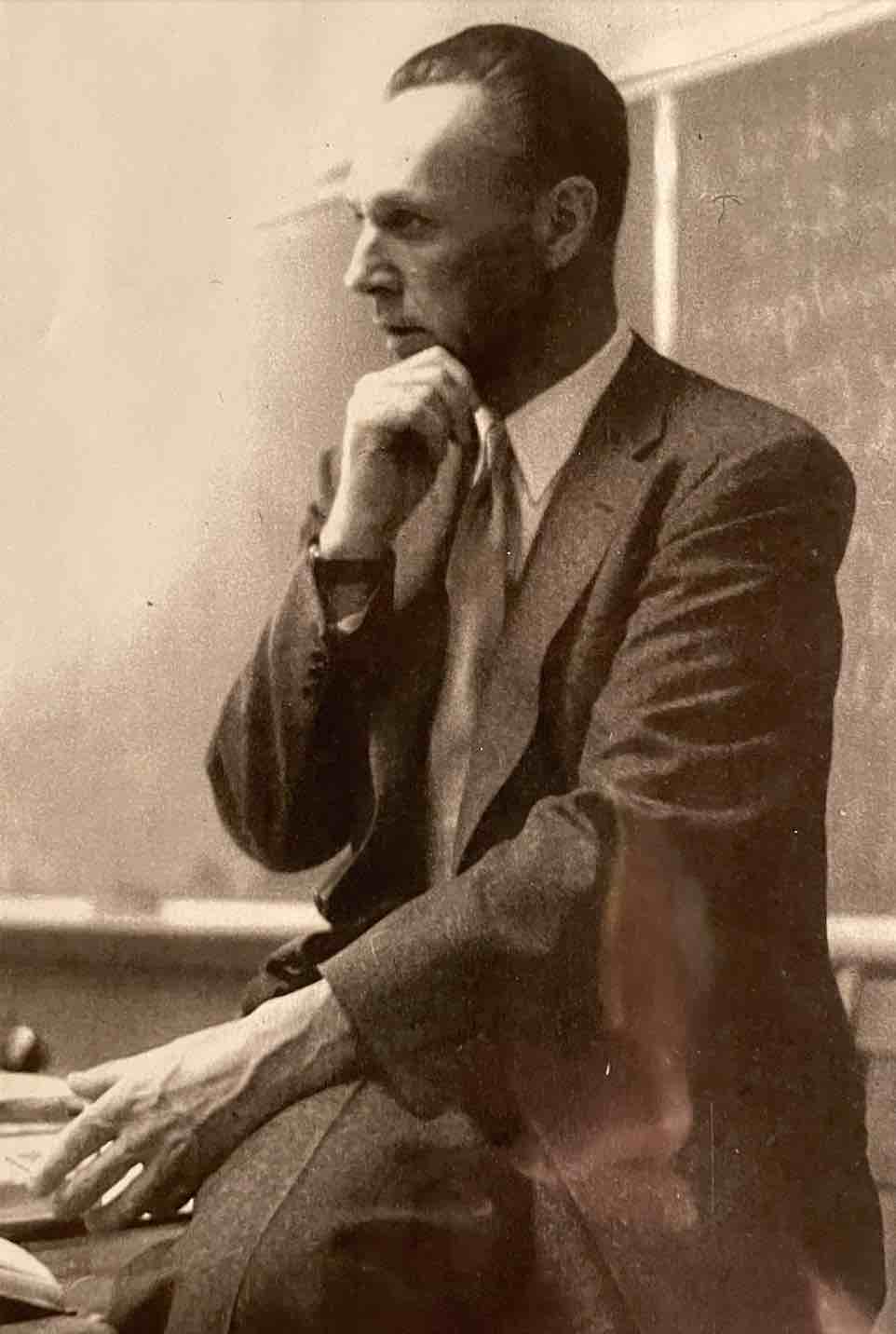 Scott A Brown
Scott A. Brown
Scott's teaching career with School Boards spanned 46 years from 1931 to 1977. He taught at the Bolton Centre School in 1933, 1934 and 1935.He was a life-long friend to Arthur and I and a colleague of mine when we were both on the staff of Rosemount High School in Montreal. He was a dedicated teacher who thought that it was his duty to help willing students to stretch and to reach their potentials. He will certainly be gratefully remembered for the aid and encouragement that he gave them. Through his efforts and support, they were able to further their education and thus be better equipped for life and for their chosen careers.
March 4, 2002 Amy F. George
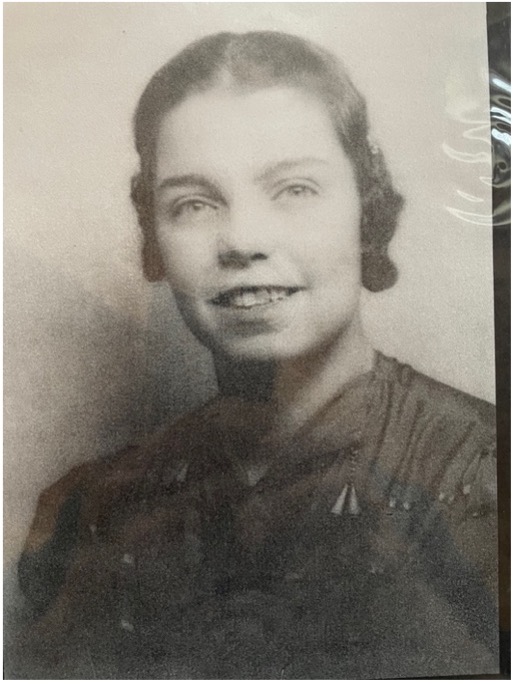 Edith Mills True
Edith Mills True
The Bolton Centre School was very lucky to have Edith as a teacher for the 1936 and 1937 school years She was energetic, conscientious and devoted to her pupils. For any serious student who wanted to pursue academic advancement, she was understandably sympathetic and generously offered guidance and support. This encouraged the pupil to work hard to improve to the best of his (her) ability and inspired he or she to continue the studies to a higher level.
Submitted by Amy F. George, March 4, 2002
January 27, 2002
Today, I am taking a sixty-year journey back in time to the Bolton Centre where I lived in 1942, in the house that is now identified as # 37, Baker Pond Road.
Traveling from north to south on the main road, I approach the village. On the left is a familiar building on which a prominent sign reads :
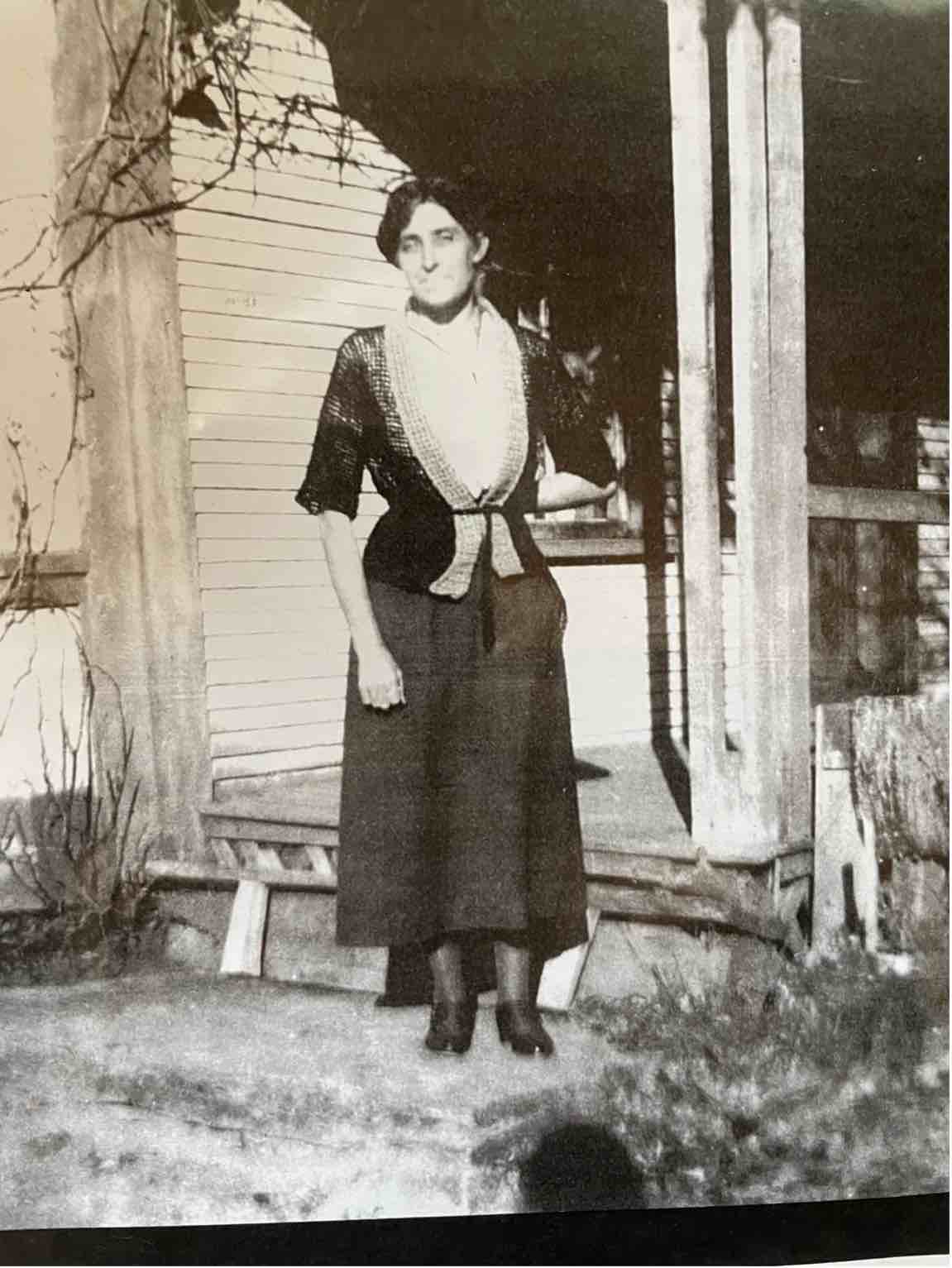 Bertie Bice
Bolton Centre
Bureau de Poste / Post Office
Bertie Bice, the eficient Postmistress, runs the business in one section of the house and uses the rest of the space for living quarters. (Today (2002), the front windows of the house can still be recognized on Rachel Neale's property at 833-835-837 Missisquoi Road.)
Continuing my journey, on the right is the Anglican Church and the Town Hall which houses the Bolton Centre School. As I near what is known as the four corners, or the crossroads, the important places on the right are the brick store and beyond it, on the northwest corner, the Peasley Hotel.
The house on the southwest corner belongs to Mr. And Mrs. Milo Willard (now the Manson residence) and across from it on the southeast corner is the home of George (Mike) McGill (where the restaurant now stands). The front of the Mary Paige Store on the northeast corner faces the road leading to Austin.
(The physical appearance of the crossroad section has changed greatly over the years. At different times, both the brick store and what had been the Peasley Hotel burned down and the building which housed Mary Paige's Store was later bought by Russell and Phyliss Marsh and was finally moved.
To its present location where it is now identified as #828 Missisquoi Road). After continuing southward on the road for a short distance, on the left, I come upon the United Church at the southern end of the village. The life style of the town was much different than it is now. Many homes still used kerosene or gas lamps. Mot heating and cooking was done by wood stoves. Some people did have water piped in by gravity but many relied on wells and indoor handpumps. Some folks carried water by the pailful from the outside wells to their homes. Imagine a world where there were no televisions or computers So lucky people owned radios which operated by large batteries. Those who had them usually invited neighbours to come and listen to favorite programs. The crank type wall telephone were used for communication but not everyone had them. Mr. And Mrs. Arthur (Blanche) Davis who lived in the house now identified as #6 Baker Pond were very accommodating about allowing the township people to use their telephone or about taking messages. One could telegraph by going to the Canadian Pacific Railway Station at Eastray (near Eastman).
Normally, one taught seven grades but since no one was scheduled for grade IV, there were only six.
Because of the different levels, in order to devote time to each grade, a certain amount of seat work had to be assigned by the teacher which was later checked.
The curriculum consisted mostly of reading, writing and arithmetic, spelling, grammar, history, geography and science. There were not too many frills; however, at Christmas time, there was a Christmas celebration upstairs in the Town Hall to which the parents were invited. The children put on a play, sang Carols and recited poems. Santa Claus arrived and distributed gifts of candy.
There was no compulsory education at that time and the attendance of pupils who lived far from the school, especially during the winter, was sometimes irregular. Even in the town, both children and teacher found it hard to trudge to school in the snow in stormy weather.
During the year, Mr. H.D. Wells, the School Inspector, made his visit. I remember that he presented me with some special work-books for my four Grade 1 students.
The year went by quickly and in June, the school closed with a picnic which everyone enjoyed.
My year of teaching at the Bolton Centre school changed my life. I liked it and soon realized that helping children to gain knowledge and to develop intellectually is very rewarding both for the students and the teacher. I decided that I wanted to be a teacher but that I needed to study and learn how to do the best job possible; therefore, I did not try to renew my Permit and my contract with the Municipality of East Bolton but rather planned to move to Montreal and go back to school.
In the late summer of 1943, Arthur has his last leave and one day, Blanche Davis sent me a message to come down to her telephone because there was a cablegram for me. When I went to the phone, The operator relayed the following communication : « Arrived safely. Love, Arthur. » I was so thankful to know that he had made the crossing safely. I was not aware of it at the time but he had landed in Scotland.
In the fall of 1943, Bessie Wells, my mother, Michael and I moved to Montreal and I enrolled in the Grade XII Teacher’s Class at the Montreal High School for girls and in June 1944, I received my Senior High School Leaving Certificate.
Because of the War, part of the MacDonald College was used by the Women’s Army, so in the fall of 1944, I enrolled in the McGill University School for Teachers and graduated in June 1945 with an Interim Intermediate Certificate which became Permanent after I had taught successfully for two years. There were 31 women and 2 men in the class.
In the fall of 1945, Arthur returned to Canada. He remained in the Army and was posted to Longue Pointe in Montreal. We settled in Rosemont, Montreal, and in 1948, our daughter, Sandra, was born.
In January 1941, Arthur George and I were married. It was World War II time and many men from Bolton Gentre were either in or thinking of joining one of the services. Arthur joined the army in May 1941. In May 1942, our son, Michael was born.
Because of the War, there was a shortage of teachers. In June 1942, I heard that the Municipality of East Bolton needed a teacher for the 1942. 1943 term for the one-room school situated in the Town Hall at Bolton Centre, Quebec and that with a High School Leaving Certificate, one could apply and perhaps be granted a Permit to teach. I had graduated from High School on June 18, 1938, so, I went to Waterloo, Quebec, to see the School Inspector, Mr. H. D. Wells, and asked for a Permit to teach which I subsequently received.
On June 27, 1942, I signed a contract with the School Commissioners of the Municipality of East Bolton, County of Brome, represented by Mr. William E. Juby, Secretary-Treasurer, for the term of 10 months from the first day of September to the end of the school year in June 1943 to teach the Bolton Centre School in District No. 6 for the sum of $55.00 a month or $550.00 for the school year.
On Level 1 of the Bolton Centre Town Hall, the school room occupied most of the southern half of the floor space and one gained entrance to it by theside door on the south side of the building. In two other locations, there was the cloakroom and further on, the toilet areas for the girls and for the boys.
There were blackboards on the west and north walls. The teachers desk stood about two feet away from the west wall and faced the east and, of course, the rows of children's desks faced the west. Behind them, there was a wood stove and a supply of wood. Before school each day a man built the fire which was red throughout the day by the teacher and older boys. A supply of water for drinking and for hand washing was also brought in daily.
Those who lived near the school went home for lunch but most including the teacher, brought their own. Recently, Eunice Mitchell Peasley, one of my former pupils, remembered the wood stove had been handy for heating hot chocolate… a most favorite drink for most children.
It was that on September 9, 1942, I introduced myself and was met by the intent gazes of 21 pair of eyes belonging to ten boys and 11 girls ranging in age from 6 to 14 years. All seemed eager and freindly. Their names in alphabetical order was :
Boys Marcel Croteau Girls Margaret Bracey
Ronald Davis Kathleen Davis
Leonard Gauvin Emily Gauvin
William Gauvin Margo McGill
Robert McGill Eunice Mitchell
Darrel Michell Eleanor Peasley
Percy Paige Mary Lou Peasley
Eric Patch Mildred Royea
Donald Proulx Myrtie May Thomas
Frederick Royea Rita Willey
I lived in Montreal for 30 years and taught 26 years for the Protestant School Board of Greater Montreal spending 16 years in elementary schools.
In 1957, I took a year off and enrolled full time in the Arts course at Sir George Williams University. In the fall of 1958, I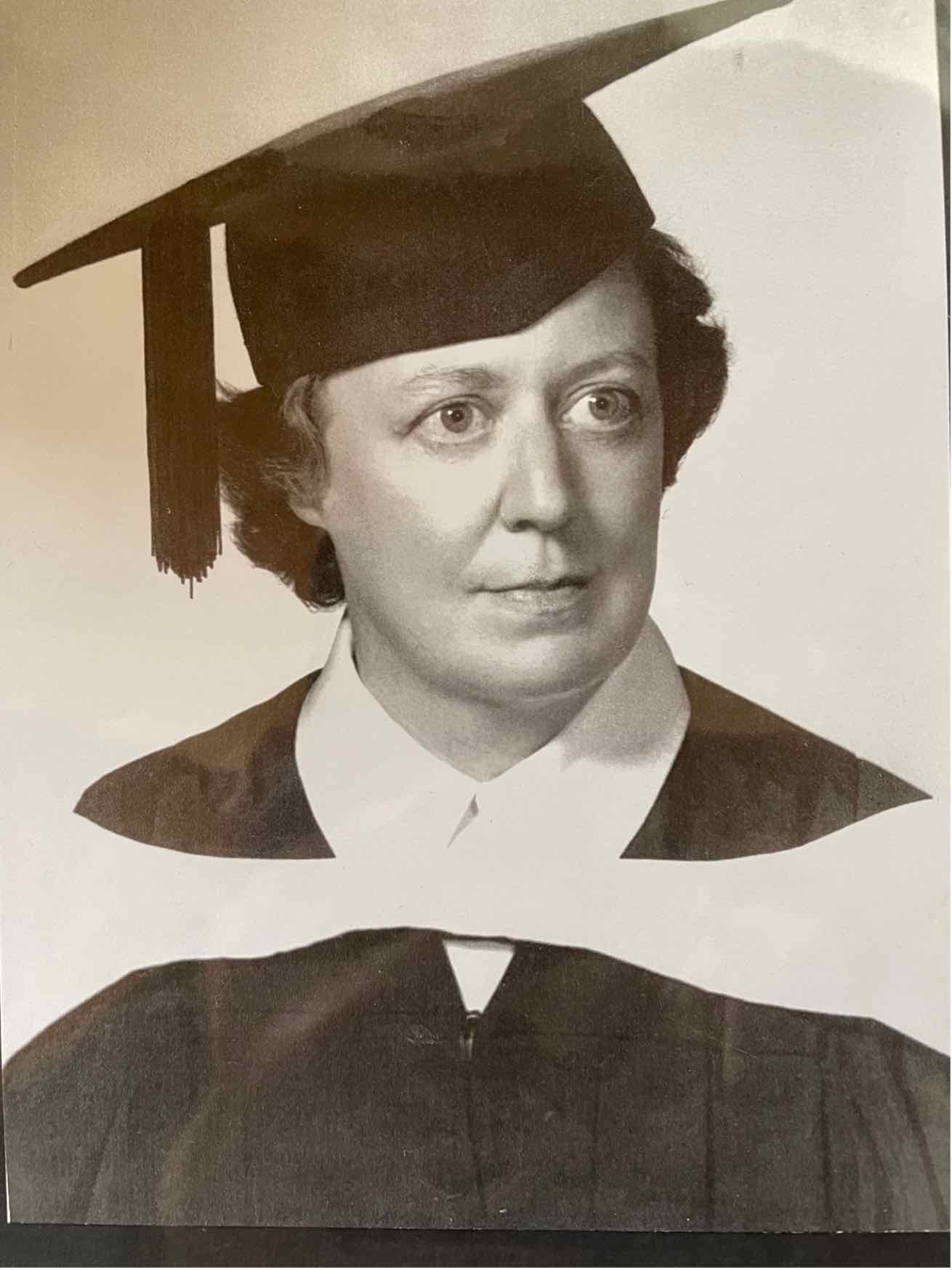 Aamy F. George resumed teaching and continued attending University two or three evenings a week and in 1960, I graduated from Sir George Williams University with a Bachelor of Arts degree and in December 1960, I obtained a Permanent Class 1 Diploma for teaching from the Department of Education, Province of Quebec. Subsequently, I spent 10 years at Rosemount High School in Montreal teaching Grades VIl to XI. I retired from there in June 1971.
Now that all my years of teaching are over, I often look back and think of the many students and classes that I had. My year in the Bolton Centre School was unique because it was my one-and-only experience in a one- room school in a rural setting.
I fondly remember my pupils as being friendly, willing and equal to most challenges. They wanted to learn and tried to do their best. Sometimes the improvement came slowly but it did come. I owe them all a debt because they whetted my appetite to choose teaching as a career.
Mrs. Amy F. Wells George