

The municipalities of the Bolton Township

Originally, this township was a single entity. But circumstances have meant that the township is now separated into seven separate municipalities.

It was in 1849 that the first fragmentation of the township occurred with the creation of the township of Magog from part of the township of Bolton and part of the township of Hatley (the Law of 1849)
Bolton Outlet (or the Outlet) was probably the beginning of the development of Magog. Nicholas Austin had built a mill there at the mouth of the Magog River where the outlet of the lake is located.
As a result, the Municipality of the Township of Bolton was created in 1855. At that time, there were several hamlets, but it was unclear which one would become the administrative center. The Town Council meetings alternated between South Bolton and Bolton Centre. However, the mining boom which occurred in 1865 with the opening of the Huntingdon mine and the two other mines further north, and especially the development of the hamlet of Dillonton, near the mine, which quickly became the most populous hamlet in the township, forced the councilors of the Municipality of the Township of Bolton to put an end to their divisions, so they built, in 1867, an imposing town hall in Bolton Centre, precisely located more in the center of the township.
 This did not prevent a second fragmentation with the creation of the municipality of West-Bolton in 1876. The rest of the township was then called East Bolton. West Bolton is geographically separated by mountains, which isolated it from the rest of the township. The settlers of this territory naturally looked West towards the village of Knowlton, the Township of Brome and its large lake of the same name. This municipality ended up attached to the county of Brome.

We can even think that the mining region located between what will become Eastman in 1888 and Bolton Center to the south was close to being attached to Eastman, a locality probably more active than East Bolton. The idea of the creation of Eastman was in the making for some time. The municipalities of Village Eastman and South-Stukely will eventually merge in 2001 and become the municipality of Eastman.

Fifty years passed before other parts of the canton's territory broke away. The municipality of Austin was created in 1938. Peasley Corner which was had been called East Bolton will become the village of Austin.

The Council of the new municipality of Austin made no objection to the creation of the municipality of Saint-Benoît-du-Lac, a project which had been planned at the same time. The municipality was formalized in 1939.
Finally, the mostly French-speaking inhabitants of the parish of Saint-Étienne-de-
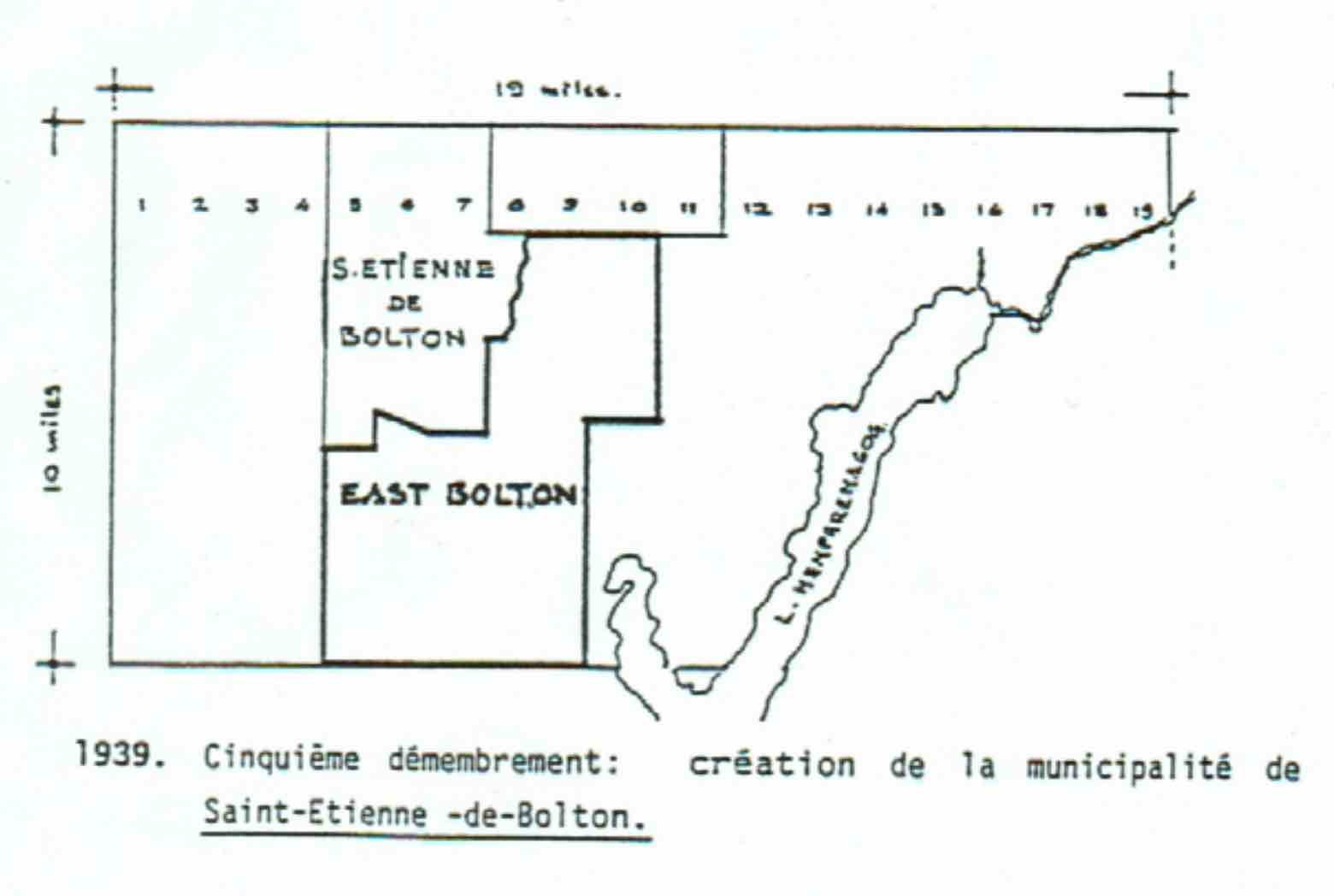 Bolton, founded in 1851 and located at the northwestern limit of East Bolton, obtained the right to become a municipality in 1939. The municipality then had approximately 300 inhabitants.