The first occupants: the Abenakis
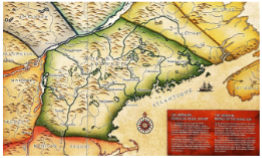
The people of the Ndakinna, which means “our land” in the Abenaki language, served as a buffer between the French and English colonizers. The French did not colonize this territory except to train the Abenaki to accompany them in raids against New England settlers and the fur trade. The French also encouraged the Abenakis to settle on the shores of the St. Lawrence so that during the British conquest their territory south of Quebec seemed unoccupied.
The Eastern Townships are essentially the territory of the Abenaki nation in southeastern Quebec, in addition to the part along the Richelieu and the Saint-Lawrence up to the Saint-François river, which had been transformed into seigneuries by the French.
The British conquest came, physically and socially, to split this vast space in two to, finally, confine the two camps to isolation. Masters in the art of dividing and conquering, the oligarchs at the head of this world empire set up the conditions conducive to ethnic division and internal quarrels by placing the various groups in competition with each other in a simple purpose of survival. Created from scratch, the new borders drawn by the English masters, on the land and in the minds of the conquered, lseparated them from their compatriots in the West as well as from all those indigenous peoples who had been their allies from the start. After the fall of New France and later the crushing of the nationalist resistance of the Métis in the West, each community gradually withdrew into its provincial identity, giving way to a sort of continental archipelago of groups belonging to a common ancestral trunk whose roots were slowly hidden. Their respective destinies then took divergent trajectories. (p.446)
…Nevertheless, against all odds, these ancient peoples [the twelve nations of Quebec] are still there…among them, The Abenakis – Wabanaki, the people of the rising sun
The Abenaki name comes from the terms "w8ban" (dawn) and "Aki" (earth), meaning "people of the rising sun". Legend has it that in the beginning, when there were only plants and animals on earth lthe Great Spirit would have carved the Abenaki and his companion in a large straight ash tree. Thus would have been born the people of the East. When the Europeans arrived, the Abenaki shared vast forest areas in what is now southern Quebec, the states of Maine, New Hampshire, Vermont, and part of New Brunswick. Abenakis settled between 1676 and 1680 in the Sillery region and then lived for about twenty years on the banks of the Chaudière River at the height of the falls, before settling in Odanak and Wôlinak, in Centre-du-Québec, at the beginning of the 18th century. An anecdote from the Franco-English wars tells the story of a warrior named Nescambuit who defended the nation from the enemies of King Louis XIV and who was received by the latter with the rank of knight.
The Waban-Aki (Abenaki) Nation now has 3,081 members, 634 of whom come from the Wôlinak communities and 2,447 from the Odanak community. The Abenakis proudly assume their cultural heritage and diligently affirm their ancestral territory with respect for traditions, but also with a view to sustainable development. This people is still renowned for its ash and sweetgrass basketry, its traditional dances , its sun masks made of corn leaves and its totems. Tourism projects allow the Abenakis to promote the development of their economy while preserving their culture and traditions. For example, since 1960, the Société historique d’Odanak has managed the first and one of the most important Aboriginal museums in Quebec, the Musée des Abénakis, which welcomes more than 5,000 visitors each year. Several Abenaki businesses are also very successful and we can cite many well-known personalities, including filmmaker Alanis Obomsawin (ONF), singer Sylvie Bernard and former Radio-Canada host Jean-Paul Nolet. (450-451) Marco Wingender, The New Forgotten World, Éditions La Métisse, 2021
The Abenakis are an indigenous nation in northeastern North America, which includes several groups of indigenous peoples. After the American Revolution of 1773, the Abenakis continued to live in their ancestral territory, which extended from the territory of the Malecites in the north, from the Atlantic in the east to the Saint-Lawrence and the Richelieu rivers in Québec to the west and Massachusetts to the south.
During this period, the Abenakis faced many challenges, including colonization and territorial expansion from the United States and Canada, which often had the effect of limiting Abenakis access to their lands and their traditional resources. Many Abenakis have been forced to leave their territory and settle in reserves or indigenous communities established by governments.
Despite these difficulties, the Abenakis continued to maintain their culture and traditions, and continued to play an important role in the native communities of northeastern North America. Today, they are still present in this region and continue to fight for the recognition of their rights and their cultural heritage. (chatGPT)
Throughout the colonial period, the Ndakina was used by the colonial powers, i.e. France and England (later Great Britain), as a buffer zone between the colonies of New France. , New England and Nova Scotia. Thus, the Nation quickly found itself drawn into the heart of Franco-British hostilities centered on the colonization and exploitation of the resources of the American Northeast. The granting and acquisition of land by the first Europeans had the effect of transforming the Ndakina and limiting its access to the Nation. This is how the significant anthropization and privatization of the ancestral territory of the W8banakiak[3] began.
After New France was ceded to the British under the Treaty of Paris in 1763, the W8banakiak established in the communities of Saint-François (Odanak) and Bécancour (W8linak) continued to hunt and fish, as of their ancestors, between Kik8ntegw (Chaudière River) and Masesoliantegw (Richelieu River), from the south shore of Kchitegw (St. Lawrence River) to the territories that will become the Eastern Townships, and even beyond in the Current states of Maine, New Hampshire and Vermont. The forests bordering Alsig8ntegw (Saint-François River) and W8linaktegw (Bécancour River) are particularly popular, as well as the edges of 8nkawbagak (Grand lac Saint-François)[1].
In the wake of the Constitutional Act of 1791, the Governor of Lower Canada chose in 1792 to divide into several townships and to concede the lands located south of the seigneuries of Kchitegw (St. Lawrence River) so that they could be inhabited by the British who fled the American War of Independence (1775-1783). The opening of the townships will cause an evolutionary loss of access to the resources which are still the basis of the diet of the W8banakiak at the turn of the 19th century. As a result, many W8banakiak hunters cross Nebesek (Lac Saint-Pierre) and hunt in the Mauricie for subsistence or commercial purposes, relying on their extensive alliance and kinship networks, so that they manage to establish and occupy family hunting territories in the Mauritian region for much of the 19th century[2].
At the same time, the authorities imposed restrictions on the hunting calendar for fur-bearing animals[3]. By restricting access to vast parcels of Ndakina and to family hunting grounds in Mauricie, the transmission of traditional knowledge and the practice of activities closely linked to the W8banakiak way of life have gradually become limited. Only guidance, which was very present until the middle of the 20th century, allowed the know-how to be perpetuated in the territory[4].
https://gcnwa.com/history-of-the-nation/
The Grand Council of the Waban-Aki Nation Inc.
Members of the great Algonquian linguistic and cultural family, the Abenakis of Québec are from the current states of Maine, New Hampshire and Vermont. In 1700, they settled permanently in Odanak and Wôlinak, on the south shore of the St. Lawrence, near Trois-Rivières.
Today, more than 2,700 Abenaki people live in Québec, including nearly 400 in Odanak and Wôlinak, in the Centre-du-Québec region. French is the language used by the majority of them, English being that of only a few.
https://www.quebec.ca/gouvernement/portrait-quebec/first-nations-inuit/profil-des-nations/abenaquis
Bibliography (Go to Suggested Reading at the bottom of the page)