Eastern Townships
The Eastern Townships, or Estrie, is a region of southeastern Quebec, crossed by the Appalachian mountain range and bounded to the south and east by Canada's border with the United States. With the exception of the trading post at Grandes-Fourches (which became Sherbrooke in 1818 - photo, 1881), the region was not settled during the French regime, so it appeared unoccupied to the British authorities after the conquest of Canada in 1760. In fact, the French saw the region as a buffer zone against the New England colonies to the south and east.
The watershed of this region is characterized by the fact that all rivers flow northwards into the St. Lawrence River: the Richelieu, Yamaska, Saint-François, Nicolet and Chaudière. The Missisquoi River seems to be an exception, flowing partly south to the border between Canada and the United States, but from there it flows west to Lake Champlain and ultimately north. The Saint-François, too, flows south at first, before forking north at Sherbrooke. The border between the two countries corresponds roughly to the watershed, as the watershed in the south flows southwards. The rivers served as routes for the Abenakis, taking them to the St. Lawrence River on the Canadian side.
The War of Independence in the 13 American colonies, which ended in 1783, resulted in the Loyalists fleeing to Canada and Missisquoi Bay, northeast of Lake Champlain. In 1791, the British governor realized that it was imperative to settle them by granting them land in the form of townships. New England Loyalists were the main source of settlement in the Eastern Townships in the late 18th and early 19th centuries. These Loyalists were people already familiar with the region's environment, which, all in all, was similar to the one they came from (New England). Likewise, they brought with them the skills of clearing land for cultivation, of harnessing waterways to make mills to grind their grain, and of building sawmills to construct their homes and other useful buildings. Adapting to the environment and activities of colonization was not as easy for immigrants from the British Isles as it had been for the Loyalists.
The Constitutional Act received Royal Assent in June 1791 and came into force on December 26. It ratified the constitutional changes that were part of the reorganization of British North America, including the creation of Upper and Lower Canada.
Sources
Encyclopédie Canadienne Brief description and history of the Eastern Townships from l'Encyclopédie canadienne
Acte constitutionnel de 1791 As per l'Encyclopédie canadienne
Acte constitutionnel selon l'Assemblée nationale du Québec
In 1792, the Canadian government created the electoral county of Buckinghamshire, which would be subdivided into townships measuring approximately 10 miles by 10 miles, to settle demobilized British
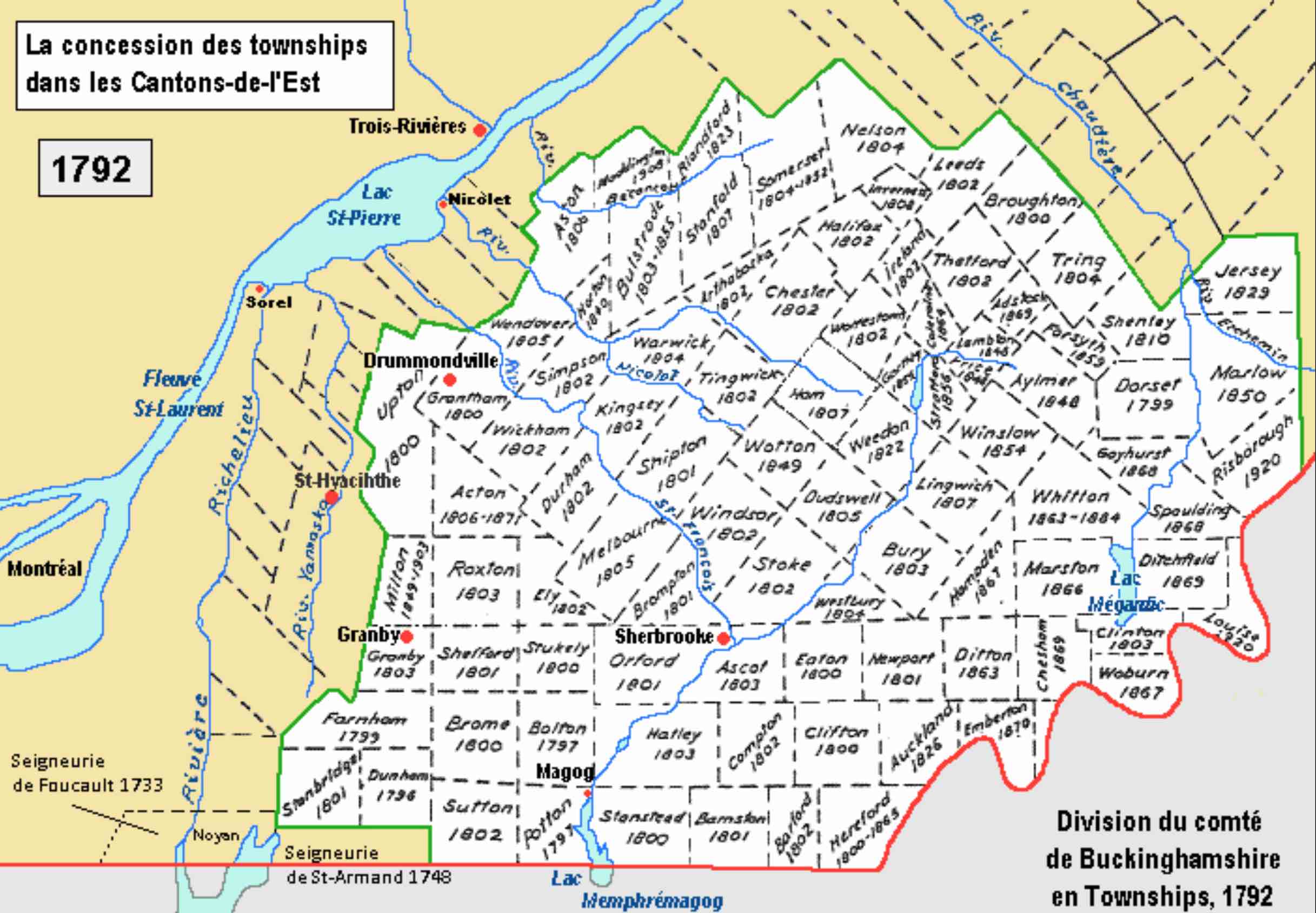
Buckinghamshire officers and soldiers. In doing so, it will allow American Loyalists to have access to it. The principle of granting cantons implies that the grantee becomes sole master of his land after obtaining his letters patent, unlike the seigneurial regime.
Buckinghamshire will quickly change its name to be called Eastern
Townships of Lower Canada in 1806. We will say Eastern Townships around 1833, then Canton de l’Est in 1858. It would be Antoine Gérin-Lajoie who gave the French name Canton de l’est which became the official name. Gérin-Lajoie is the author of the novel Jean Rivard and the song Un canadien errant.
Autoroute 10 or Autoroute des Cantons de l’Est, built in 1963 and 1964, links Montreal to Sherbrooke, facilitating accessibility to the region and allowing its tourist development.
In 1981, the Quebec government created the administrative region of Estrie, but the expression Cantons de Map of the administrative region of Estrie with the MRCs persists because it is more in line with the reality of the land and history. As for the name Estrie, it seems to have value only for the administration. For the administration, the Eastern Townships would no longer exist. However, the Eastern Townships still exist as a tourist region that includes Brome County and Haute-Yamaska. Even Bolton-Ouest is part of the tourist region but not of Estrie.
For more details, please consult the website of Université Laval.
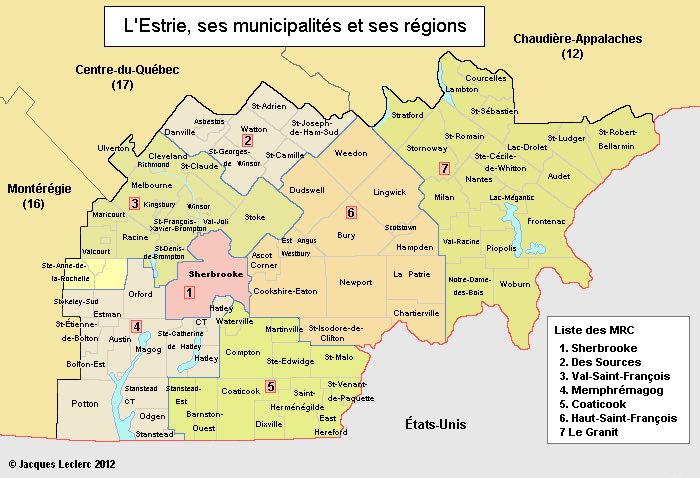
Carte de la région administrative de l'Estrie avec les MRC
The first of the 95 townships granted was Dunham Township in 1796, followed by Bolton and Potton in 1797.
After the Loyalists, came a wave of British immigrants from 1820, mainly soldiers demobilized after the end of the Napoleonic Wars. The British American Land Company, Balco, was created and acquired some 850,000 acres of land in 1833 to encourage British settlers to come and settle there while England was in the grip of overpopulation and famine. There was the arrival of the Irish around 1820, then between 1840 and 1850, and also the Scots in 1835, 1845 and 1854. All these immigrants dispersed throughout the townships.
After 1840, French-speaking colonization became increasingly important. Given the rapid increase in the French-speaking population in Quebec, the Church and the Canadian Institute ensured that French-speakers became the majority during the 1870s. Today, English-speakers represent less than 10% of the population. For more information on the waves of migration, consult the website of Marc-Olivier Mailhot.
It should be noted that the Eastern Townships are essentially the part of the territory of the Abenaki nation that is located in southern Quebec, in addition to the part that the French regime had already divided into seigneuries along the east bank of the Richelieu and the St. Lawrence.
Also, this region would have been colonized, eventually, by French Canadians given the strong growth of this community in the 19th century, had it not been for colonization by the Loyalists.
